WSI’s Warehouse Wire: October 23, 2026
Your connection to what’s happening in warehousing, transportation, and supply chain operations.
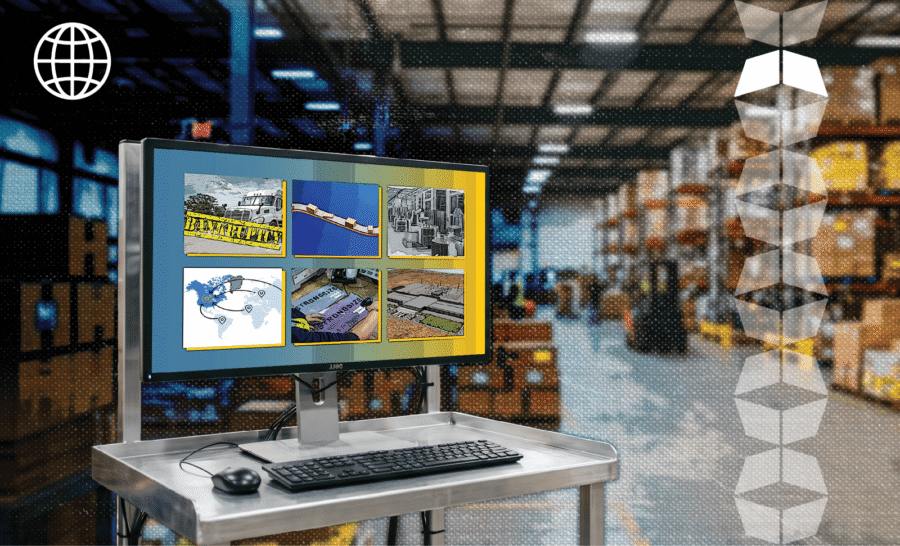
October’s logistics news shows a supply chain investing for the future while managing pressure in the present. Smaller trucking companies continue to struggle with debt and shrinking fleets, while manufacturers are putting new technology and capacity behind efforts to strengthen domestic production.
A new reshoring platform aims to connect U.S. manufacturers directly with existing import demand. Plus, Zebra and Impinj are extending RFID into products that have historically been difficult to track at the item level. NVIDIA, meanwhile, is backing a significant expansion in semiconductor manufacturing and testing capacity as AI infrastructure demand grows.
Industrial AI is also moving deeper into operations. U.S. CPG manufacturers are adopting the technology faster than their global peers, while McKinsey sees AI as one part of a reset underway across packaging and paper.
Closer to home, WSI Director of Rail Relations Billy Vance was featured in Inbound Logistics, where he explained why transportation infrastructure only delivers value when the people and operations around it keep freight moving.
Check back monthly for timely headlines and practical insight into warehousing and supply chain operations.
Trucking bankruptcies expose continued pressure among smaller carriers
Financial pressure remains visible across the U.S. trucking market. At least 16 trucking and transportation companies filed for bankruptcy protection between September 18 and October 21, according to a FreightWaves review of federal bankruptcy records.1 The companies span general freight, petroleum transportation, logging, and other transportation segments.
Some filings show how quickly carrier finances can deteriorate. Texas-based Site2Site Transport reported approximately $2.1 million in gross revenue in 2024 before revenue dropped about 24% in 2025. Its bankruptcy filing reported no gross revenue from the beginning of 2026 through its September filing. Chicago-based Midwest Expedited reported about $2.31 million in liabilities against roughly $108,000 in assets.
Most of the carriers identified are relatively small operations, which makes the story less about an immediate nationwide capacity shortage and more about continued financial fragility at the smaller end of the trucking market. Carrier exits can reduce options on individual lanes even when national capacity remains available. They can also create disruption when transportation strategies depend heavily on a small number of regional providers.
The latest filings demonstrate the value of understanding the financial and operational stability behind carrier capacity, particularly for manufacturers moving specialized freight or serving locations with fewer transportation alternatives.
Packaging and paper enter an era that requires a new execution
Packaging and paper companies can no longer count on the demand growth that supported the industry for much of the past decade, according to a new McKinsey compendium examining the sector’s changing economics.2 Weak demand and inflationary cost pressure have slowed revenue and margin growth across paper, plastics, glass, and metal packaging. McKinsey argues that companies will have to rely more heavily on operational execution as price increases and volume growth become less dependable sources of performance. Leading companies have already achieved organic growth more than 200 basis points above the market through targeted commercial-excellence initiatives.
Inventory strategy is adding another complication. CPG companies are reducing working capital tied up in supply chains, which McKinsey says is creating more volatile ordering patterns and moving a greater share of inventory risk upstream.
Technology is part of the industry’s response. McKinsey sees targeted AI applications supporting commercial functions and operating-model improvements rather than broad deployment for its own sake. The research also points to cost management, portfolio decisions, and footprint optimization as important strategies in the current environment.

New platform looks for reshoring opportunities inside existing import demand
A new technology platform is approaching reshoring from the demand side rather than asking manufacturers to first identify products they could bring back to the United States.
Reshore Technologies launched an import-substitution intelligence platform designed to match products U.S. companies currently import with domestic manufacturers that already make, or may have the capability to make, comparable goods.3 The company points to more than $3.4 trillion in U.S. goods imports during 2025 as the potential market it is trying to make easier to navigate.
Manufacturers create profiles detailing their products and capabilities. The platform maps those products against Harmonized Tariff Schedule classifications and import activity to identify potential customers. Importers can search the system from the opposite direction to find U.S. suppliers that could support a sourcing change.
More than 100 users representing over 40 organizations participated in an earlier West Virginia pilot, according to the company. Participants included manufacturers and importers as well as economic development organizations. The concept addresses one practical obstacle to regionalizing supply chains: visibility. A company may want another domestic source without knowing where qualified capacity exists.
Finding a supplier is still only the beginning. Successful reshoring also changes inbound transportation, inventory flows, and warehouse requirements. As sourcing moves, the distribution network supporting it may need to move as well.
RFID upgrades target harder-to-track inventory
Item-level RFID visibility is expanding into products that have traditionally been difficult to read reliably. Zebra Technologies is adding support for Impinj Gen2X across handheld, sled, fixed, and overhead RFID readers.4 The technology is designed to improve performance around densely packed merchandise and products containing materials such as liquids or metals, which can interfere with conventional RFID reads.
RFID use is spreading into grocery, health and beauty, pharmaceuticals, jewelry, and other categories where item-level tagging has historically presented technical challenges. Better read performance can support inventory visibility and supply chain traceability while improving autonomous track-and-trace applications.
The upgrade also shows how warehouse automation depends on data quality at the physical level. Inventory software can only act on the information its sensors capture. Missed reads can become incorrect inventory records, unnecessary searches, or replenishment decisions based on incomplete information.
As warehouses add automation and AI-supported decision-making, technologies that establish where products actually are become foundational. Better item-level visibility can improve the data feeding those systems before an algorithm ever makes a recommendation.
NVIDIA backs major capacity expansion across its manufacturing network
The AI infrastructure boom is producing a physical manufacturing buildout across NVIDIA’s supply chain. NVIDIA announced agreements with suppliers covering substrates, advanced packaging, semiconductor testing, and optical engines. Together, substrate agreements with IBIDEN, Samsung Electro-Mechanics, and Unimicron are expected to support a 2.5-times increase in capacity over the next three years. Amkor plans to increase advanced packaging capacity by more than 300% by the end of 2028.5
The expansion also includes new U.S. manufacturing investment. NVIDIA is providing a $1.1 billion capacity reservation advance to King Yuan Electronics to support new testing facilities and equipment in the United States, with high-volume production targeted for April 2027. NVIDIA expects its total semiconductor testing capacity to double between 2026 and 2027.
The agreements highlight the scale required behind digital infrastructure. AI growth translates into demand for factories, production equipment, component inventories, transportation capacity, and the industrial real estate needed to support those operations.
NVIDIA is also spreading that capacity across the United States and several Asian manufacturing markets. That provides additional production capability while creating more redundancy across critical parts of the network. The result is another example of technology spending becoming a manufacturing and logistics story. Data center demand may begin with computing capacity, but fulfilling it requires a global physical supply chain capable of scaling at the same pace.
U.S. CPG manufacturers move faster on industrial AI
U.S. consumer packaged goods manufacturers are adopting AI at a faster pace than their global peers, according to new Schneider Electric research released during PACK EXPO International.6 Twenty-nine percent of U.S. CPG manufacturers surveyed said AI is already embedded end to end in core operations and decision-making, compared with 13% globally. More than half of U.S. respondents have deployed AI across multiple sites or processes, nearly double the 27% global figure.
The investment is happening against significant operating pressure. U.S. CPG manufacturers estimate that downtime, waste, delays, rework, and inefficient asset use cost them about 20% of potential manufacturing revenue. Schneider projects those losses could rise without operational improvements.
That helps explain why industrial AI adoption looks different from many consumer-facing applications. Manufacturers are applying technology against specific operating problems where equipment performance and production efficiency have measurable financial consequences.
The findings also carry implications beyond the factory floor. Production systems do not operate independently from inventory and distribution. Better forecasting or asset utilization can change material requirements and outbound volumes, while unreliable warehouse or transportation data can limit how effectively manufacturers respond.
Schneider argues that connected data and automation remain necessary foundations for AI. The pattern is similar across the supply chain. AI can improve decisions but its value depends on the operational systems and data underneath it.

Billy Vance highlights the execution behind logistics-ready sites
Transportation infrastructure may determine where freight can move, but execution determines whether the network performs as intended. That distinction was central to a new Inbound Logistics feature7 examining what makes certain U.S. locations stand out for logistics investment.
The article features WSI Director of Rail Relations Billy Vance alongside leaders from major ports and supply chain experts. WSI is highlighted for its national distribution network, rail-served warehouses, transloading capabilities, and specialized logistics operations.
“Rail can be a tremendous advantage for shippers moving high-volume products,” Vance told Inbound Logistics. But the infrastructure alone is not enough. Railcars still have to move efficiently through facilities, labor and equipment need to be available when freight arrives, and operators need visibility into shipments.
This is relevant as manufacturers reconsider warehouse locations and transportation networks. A rail siding, nearby interstate, or port connection creates an opportunity. The value comes from how those assets work together day to day.
Vance also pointed to relationships as a part of that operating infrastructure. Established connections with railroad personnel and customers can make it easier to address problems before they create larger delays. The article ultimately makes a case for evaluating logistics locations beyond geography. Connectivity matters, but experienced operators turn that connectivity into a functioning supply chain.
References:
- https://www.freightwaves.com/news/new-trucking-bankruptcies-expose-mounting-debt-and-shrinking-fleets
- https://www.mckinsey.com/industries/packaging-and-paper/our-insights/defying-disruption-a-new-packaging-and-paper-growth-strategy#/
- https://www.supplychaindive.com/press-release/20261001-reshore-technologies-launches-platform-to-connect-american-manufacturers-wi-1/
- https://www.supplychaindive.com/press-release/20260925-zebra-technologies-upgrades-rfid-readers-with-impinj-gen2x-for-improved-ite/
- https://nvidianews.nvidia.com/news/nvidia-and-supply-chain-partners-expand-capacity-to-accelerate-ai-infrastructure-buildout
- https://www.automationworld.com/analytics/news/55413828/schneider-electric-data-shows-us-cpg-manufacturers-lead-global-ai-adoption
- https://www.inboundlogistics.com/articles/stand-out-sites-build-for-speed/
About the Author

Alyssa Wolfe
Alyssa Wolfe is a content strategist, storyteller, and creative and content lead with over a decade of experience shaping brand narratives across industries including retail, travel, logistics, fintech, SaaS, B2C, and B2B services. She specializes in turning complex ideas into clear, human-centered content that connects, informs, and inspires. With a background in journalism, marketing, and digital strategy, Alyssa brings a sharp editorial eye and a collaborative spirit to every project. Her work spans thought leadership, executive ghostwriting, brand messaging, and educational content—all grounded in a deep understanding of audience needs and business goals. Alyssa is passionate about the power of language to drive clarity and change, and she believes the best content not only tells a story, but builds trust and sparks action.