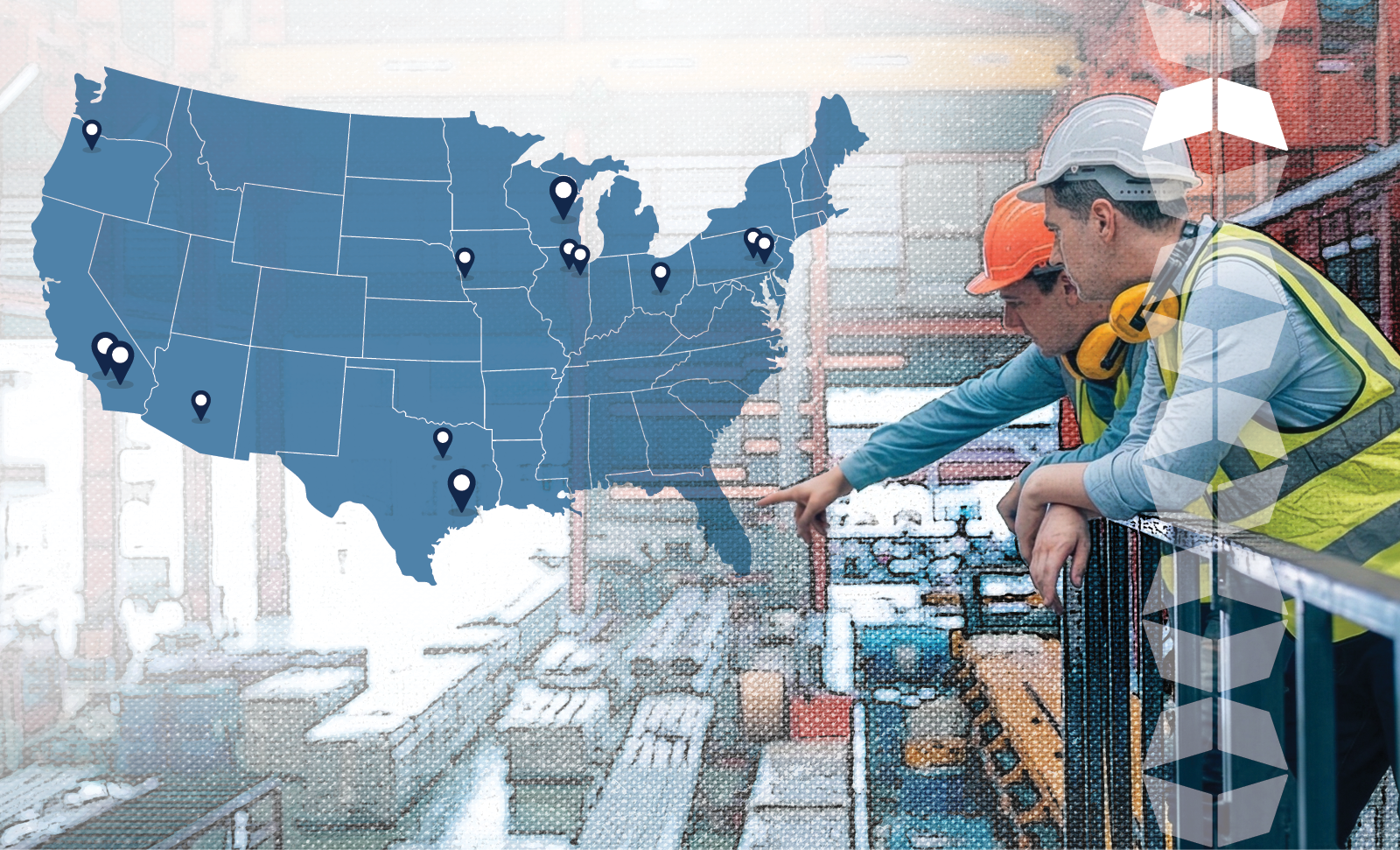
Top Manufacturing Hubs in America, and What They Mean for Your Supply Chain
Across America, manufacturing remains clustered in a handful of states and regions, each with distinct infrastructure, labor dynamics, and transportation advantages. And the decision of where manufacturing plants, inventory, and distribution nodes sit relative to those clusters quietly shapes cost structure more than almost anything else on the P&L.
According to the U.S. Bureau of Labor Statistics, states like California, Texas, Ohio, and Michigan lead the country in manufacturing employment and facility count, with California alone supporting more than 1.2 million manufacturing jobs. These concentrations aren’t random. They reflect decades of investment in industrial infrastructure, proximity to raw materials, and access to major transportation corridors.
Today, they also highlight where manufacturing supply chain networks can either gain or lose efficiency depending on how they are designed.
Where Manufacturing Activity Is Concentrated
While manufacturing spans all 50 states, a handful of them do most of the heavy lifting. This table highlights a few that stand out for their scale and specialization.
Leading states by manufacturing activity
| State | Key Strengths | Supply Chain Advantage |
| California | Electronics, aerospace, biomedical | Port access, global trade connectivity |
| Texas | Energy, chemicals, aerospace | Central location, strong freight network |
| Ohio | Automotive, machinery | Proximity to Midwest industrial base |
| Michigan | Automotive, advanced manufacturing | Deep supplier ecosystem |
| Indiana | High output per capita | Dense industrial network |
| North Carolina | Pharma, food processing | Growing Southeast logistics hub |
| Wisconsin | Food, industrial manufacturing | Regional distribution strength |
Sources: National Institute of Standards and Technology
These states anchor broader supply chain ecosystems. Suppliers, distribution centers, and transportation networks cluster around them, creating both opportunity and complexity for manufacturers scaling operations.
The Regions Powering U.S. Manufacturing
Beyond individual states, manufacturing strength can also be assessed at the regional level.
Great Lakes and Midwest: The industrial backbone
The Great Lakes region, including Ohio, Michigan, Indiana, Illinois, and Wisconsin, remains the core of U.S. manufacturing. The area dominates automotive, heavy machinery, and industrial production and is supported by rail infrastructure and proximity to both domestic and Canadian markets.
This region offers strong inbound advantages for raw materials and components, especially for companies that rely on big and bulky or rail-served freight.
Southeast: Growth and expansion
States like North Carolina, Georgia, Tennessee, and South Carolina are seeing rapid manufacturing growth, particularly in automotive and aerospace.
Lower operating costs and access to ports like Savannah and Charleston have made the Southeast a rising destination for new production facilities. As a result, distribution networks are expanding quickly to support outbound flows.
West Coast: Innovation and global access
California and Washington lead in high-tech, aerospace, and food production. The West Coast is defined by its proximity to major ports, making it a critical entry point for imports and a gateway for exports.
However, congestion and higher costs often require supply chains to extend inland to maintain efficiency.
Why Manufacturing Supply Chain Location Matters
Manufacturing location anchors the entire supply chain. It sets the floor on your inbound transit times, dictates where inventory should sit, and locks in a big chunk of your transportation spend before you’ve shipped a single order.
Yet manufacturing output isn’t always concentrated in the largest states. According to US Census Bureau data, it often clusters in highly specialized regions.
For example, Louisiana ranks first in manufacturing shipments per capita, driven largely by petroleum and chemical production, while states like Indiana and Kentucky also rank near the top due to strong transportation equipment manufacturing.
WSI’s operations team sees this play out every day. The company runs dedicated distribution centers in places like Council Bluffs, Iowa — a critical node for agrochemical distribution into the Plains — and Houston,Texas where a global specialty materials manufacturer stages product for Gulf Coast distribution.
The biggest states on a headcount map aren’t always the densest on an output map.

According to Jesse Jones, VP of Operations at WSI, “the best distribution markets aren’t always the biggest ones and that’s where warehouse network design gets interesting.”
States with high manufacturing output often require more complex logistics networks to manage dense flows of materials and finished goods. “Without the right infrastructure and positioning, even short distances can create inefficiencies” says Jones.
Building A Supply Chain Network Around Manufacturing Hubs
Today’s manufacturers are beginning to design supply chains that align with these geographic realities rather than working around them.
This is where an experienced manufacturing 3PL becomes critical. A partner with a well-placed network can help:
- Optimize inbound freight flows from suppliers
- Strategically place inventory closer to production or demand
- Manage storage for high-volume or specialized goods
- Coordinate outbound distribution across regions
- Reduce transportation costs through network design
Instead of relying on a single facility, many manufacturers are moving toward multi-node networks that mirror where production and demand intersect.
The Role of 3PL Infrastructure in Manufacturing Regions
Not all logistics networks are built to support manufacturing supply chains at scale.
Heavy materials, high-SKU environments, and regulated products require specialized infrastructure; something not every provider can offer. Raw materials and components often arrive by rail, which means a 3PL without track access isn’t even in the conversation for bulk commodity customers — and transloading rail to truck efficiently is its own discipline.
In established manufacturing regions, the right 3PL brings things such as rail-served facilities for bulk inbound materials and high-capacity storage for oversized or dense products. They also feature systems designed for complex inventory management and transportation networks aligned with industrial corridors.
Multi-tenant warehousing isn’t the only option. For steady, high-volume flows, dedicated contract warehousing — a facility operated exclusively for one customer, often in a build-to-suit or co-located model — is usually the better economic answer. It’s how the most committed manufacturing customers get the benefits of outsourcing without the compromises of sharing space.
In established manufacturing regions, the right 3PL brings all of that together under one roof: rail-served docks for bulk inbound, high floor loads and tall clear heights for oversized product, documented compliance programs for regulated commodities, inventory accuracy that keeps customer production lines moving, dedicated or shared models depending on what fits, and carrier networks that run the industrial corridors instead of the ecommerce lanes.
That choreography matters most in regions like the Midwest, where a single load might arrive by rail from a Canadian pulp mill, get transloaded to truck at a Wisconsin facility, and leave the building on a flatbed headed for a converter in Ohio before the end of the shift. The 3PLs that can run that sequence reliably and have been running it for decades are a much smaller field than the ones that claim they can.

Aligning Location with Supply Chain Strategy
As manufacturing evolves, warehouse network design must be intentional.
Companies should consider whether inventory should sit near production or closer to customers and how to balance port proximity with inland efficiency. It’s also essential to assess which regions provide the best long-term scalability and how to reduce risk by diversifying network locations.
There is no single “best” location. The right strategy depends on product type, customer base, and growth plans. What remains consistent is the importance of alignment between manufacturing locations, logistics infrastructure, and transportation strategy.
Where WSI’s Warehouse Network Supports Manufacturing Operations
WSI’s warehouse network is intentionally positioned within the core manufacturing corridors that drive U.S. production, allowing inventory to move efficiently between suppliers, plants, and end markets.
In the Midwest, particularly Wisconsin, Illinois, and Ohio, facilities support high-volume industrial operations with proximity to automotive, paper, and machinery manufacturing, along with access to rail-served inbound freight for raw materials. And Central Wisconsin plays a critical role for paper, packaging, and bulk goods, where high-capacity space and specialized handling are essential.
Further south, Texas and the Gulf Coast anchor chemical and industrial manufacturing supply chains. Facilities in these regions are well suited for bulk storage, hazmat-compliant operations, and import/export flows tied to port activity, creating a direct link between global supply and domestic production.

Across these locations, WSI warehouses function as extensions of the manufacturing floor, supporting inbound material staging, buffering production schedules, and positioning finished goods for outbound distribution. By operating within these established industrial hubs, WSI helps manufacturers reduce transit time for raw materials, maintain consistent production flow, and build distribution networks that are aligned with both where goods are made and where they need to go next.
Connect with the WSI team to design a manufacturing-focused logistics network that aligns your production and distribution for stronger performance.
About the Author

Alyssa Wolfe
Alyssa Wolfe is a content strategist, storyteller, and creative and content lead with over a decade of experience shaping brand narratives across industries including retail, travel, logistics, fintech, SaaS, B2C, and B2B services. She specializes in turning complex ideas into clear, human-centered content that connects, informs, and inspires. With a background in journalism, marketing, and digital strategy, Alyssa brings a sharp editorial eye and a collaborative spirit to every project. Her work spans thought leadership, executive ghostwriting, brand messaging, and educational content—all grounded in a deep understanding of audience needs and business goals. Alyssa is passionate about the power of language to drive clarity and change, and she believes the best content not only tells a story, but builds trust and sparks action.