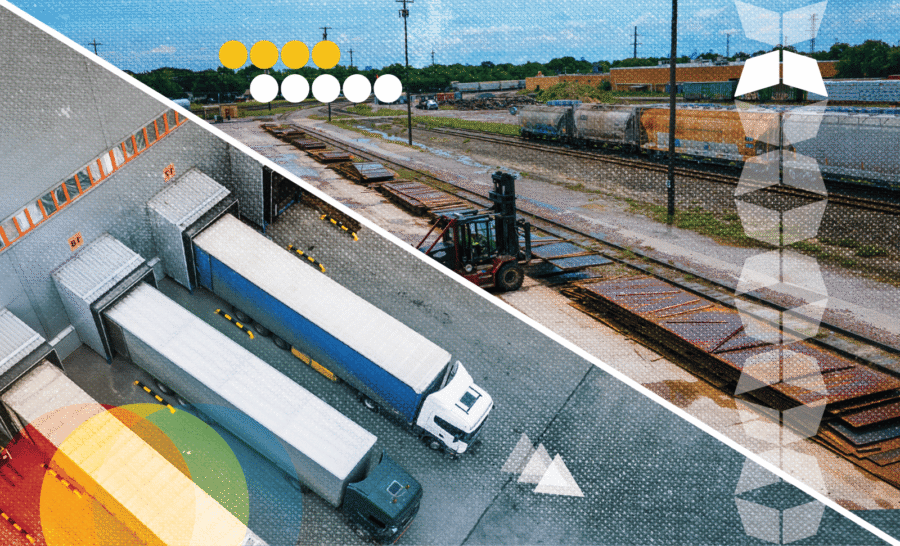
Rail vs Truck Shipping: When Does Rail Make Sense?
Rail vs truck shipping is worth a look when fuel costs rise, industrial volumes concentrate, or a manufacturer needs to serve several markets from larger inbound moves.
Rail’s fuel advantage is well established. The Association of American Railroads says rail moves a ton of freight nearly 500 miles per gallon on average, about three to four times as efficiently as trucks. That industry-wide operating statistic is not a promise of an equivalent percentage saving on a specific shipment though. Rates, access, handling, inventory, and service all have to be modeled.
Rising fuel costs are changing shipping economics
Elevated diesel prices are giving manufacturers another reason to evaluate rail vs truck shipping. The U.S. Energy Information Administration reported a national average diesel price of approximately $6.20 per gallon on October 5, 2026, compared with $5.60 on August 31. Prices have eased from the record $6.53 set the week of September 21, but fuel remains a significant cost pressure heading into peak shipping season.
For truck shipments, higher diesel costs can reach manufacturers through fuel surcharges or adjustments to quoted transportation rates. The effect varies by lane and agreement, so an unchanged base rate does not necessarily mean an unchanged freight bill. Longer distances increase exposure to fuel costs, making transportation efficiency particularly relevant for manufacturers moving heavy products over extended routes.
That pressure is already influencing some shipping decisions.On September 16, Union Pacific CFO Jennifer Hamann told an investor conference that higher diesel prices were prompting some customers to move freight from trucks to rail, citing rail’s fuel-efficiency advantage.
Rail is also exposed to higher fuel costs. Union Pacific’s applicable mileage-based carload fuel surcharge increases from 68 cents per mile in October to 84 cents in November, based on earlier monthly diesel averages. These types of fuel adjustments can lag changes at the pump and continue affecting freight bills after prices begin to decline.
The opportunity for savings depends on the complete route. Rail may improve long-distance economics, but drayage, transloading, and final truck delivery add costs of their own. Storage needs and additional inventory in transit also affect the comparison. Higher diesel prices can strengthen the case for rail on suitable lanes, but a lower linehaul rate alone does not establish a cheaper or more reliable supply chain.

Four questions to screen a potential rail lane
Four questions can help manufacturers and shippers identify which lanes are worth evaluating for rail. Shipment volume, product characteristics, distance, and timing flexibility provide an initial screen before comparing the full costs and service requirements.
| Factor | Rail is worth modeling when… | Truck may retain the advantage when… |
| Volume | Heavy or repeatable flows can fill cars or support predictable releases. | Loads are small, sporadic, or require frequent partial shipments. |
| Commodity | Product is dense, durable, or can be secured and handled in an appropriate car. | Product is highly time-sensitive, low-density, or costly to touch again. |
| Geography | A long lane has practical rail origin and destination access, with a manageable final truck leg. | The move is short or transload and drayage erase the linehaul benefit. |
| Timing | Inventory can be staged and replenishment planned around rail variability. | A missed delivery window would interrupt production or a customer commitment. |
A more in-depth look at what to ask
1. Is there enough repeatable volume?
Rail economics depend on load density, frequency, and the ability to use the chosen car type. A manufacturer moving less than a truckload occasionally on a lane is unlikely to justify a dedicated carload strategy. Regular flows of around 50 tons are worth a closer look, though car capacity varies by type, and a rail-to-truck distribution model can aggregate multiple destinations.
Shippers should use the last 12 months of shipment data to show tons, cube, frequency, seasonality, and destination clusters. Ask whether shipments can be consolidated without creating too much inventory or missing customer dates. The Federal Railroad Administration identifies heavy freight moving long distances as a common rail fit and notes that bulk commodities make up a substantial share of carloads.
2. Can the commodity tolerate the journey and handling?
Steel, lumber, plastics, paper, food ingredients, aggregates, and chemicals can be strong candidates when the equipment, loading method, and receiving controls fit the product. “Nonperishable” alone is insufficient: some sensitive products can move by rail with the right service and equipment, while a durable product can still be damaged by poor securement or an extra touch.
Specify the required car, load pattern, packaging, handling method, and condition checks. For roll paper, a low rate is no bargain if damaged edges or cores reduce usable yield. For chemicals, compatibility, regulated handling, and facility capabilities can determine whether the proposed network is feasible.
3. Does the geography support the modal shift?
Longer lanes give rail’s scale more room to offset the fixed work at both ends. Under roughly 300 miles, the extra handling may be hard to justify; beyond roughly 500 miles, the lane may merit closer study. These are helpful for screening, not published break-even rules. A short lane with direct sidings can work, while a long lane with costly drayage at both ends can fail.
Map the actual origin and destination, serving railroads, interchange points, transload locations, and truck miles. Request door-to-door quotes that include switching and any shortline charges, not just the railroad’s linehaul. Check whether the warehouse can receive full cars, store the freight, and release the smaller quantities customers want.
As an example, WSI’s network offers one model for connecting inbound carloads with regional truck distribution.
4. How much timing flexibility exists?
Rail schedules, interchange, car placement, and unloading add variability that a direct truck move may avoid. If a plan assumes five to seven days of dwell or transit, validate that estimate with the railroad for the specific lane. Dwell is time a car spends at a yard or facility; total transit and order-to-delivery time are different measures.
Ask whether the manufacturer can hold inventory nearer the customer and replenish it before demand spikes. A just-in-time production part with no buffer may remain better on truck. Building products or paper rolls that can be staged for days or weeks may fit rail-served storage. The warehouse then absorbs the large inbound shipment and schedules smaller outbound truck deliveries to match customer demand.

Comparing total landed cost and network risk
Shippers should build a lane model with linehaul, origin loading, destination unloading or transload, drayage, storage, final-mile trucking, and expected accessorials. Add inventory carrying cost and the financial consequence of a late or damaged shipment. Price railcar time and define who is responsible for release.
Run scenarios for normal, surge, and disrupted weeks. A full railcar may reduce cost per ton yet leave more inventory at one point in the network. A rail-served warehouse can turn that concentration into a useful buffer if it has space, visibility, handling capacity, and a reliable truck network. It can receive full-car quantities, hold them at an agreed cost, and release them when customer demand or truck availability warrants. That flexibility is particularly relevant for lumber, steel, polymers, paper, and other industrial products that can be staged safely.
Also compare service risk. Who receives shipment milestones? What happens if several cars are placed at once? Is there a second warehouse or truck option if the line is disrupted?
The WSI rail freight logistics resource center outlines the roles of the shipper, rail carrier, and transload operator. Assigning those roles before the first move prevents a low-cost lane from becoming an unmanaged exception.
Making the decision by lane
Rail vs truck shipping is most promising when substantial freight moves predictably over a useful distance, and the network can receive, store, and distribute it without too many added touches.
Truck retains an important role in time-critical delivery and the final leg of many rail moves. The right answer may be a mix of both modes by customer, product, and season.
In short, rail makes sense when its transportation savings hold up across the full journey and its service schedule fits the manufacturer’s needs. Rail-served warehousing can strengthen that fit by holding bulk inventory closer to demand and supporting smaller final deliveries by truck. The value comes from matching each mode to the work it handles efficiently, with the complete route determining both cost and reliability.
About the Author

Alyssa Wolfe
Alyssa Wolfe is a content strategist, storyteller, and creative and content lead with over a decade of experience shaping brand narratives across industries including retail, travel, logistics, fintech, SaaS, B2C, and B2B services. She specializes in turning complex ideas into clear, human-centered content that connects, informs, and inspires. With a background in journalism, marketing, and digital strategy, Alyssa brings a sharp editorial eye and a collaborative spirit to every project. Her work spans thought leadership, executive ghostwriting, brand messaging, and educational content—all grounded in a deep understanding of audience needs and business goals. Alyssa is passionate about the power of language to drive clarity and change, and she believes the best content not only tells a story, but builds trust and sparks action.