Why Manufacturers Prioritize Control Over Cost When Choosing a Warehouse Model
A warehouse model can look efficient on paper and still fail the operation that depends on it. For many producers, manufacturing inventory control has become central to the deciding the warehouse question: “Which option gives us the clearest command of inventory, service, and risk?”
WSI’s 2026 survey of 306 U.S. manufacturing supply chain, operations, and logistics leaders found that inventory control was the most frequently cited driver of warehouse capacity decisions, selected by 47% of respondents. Transportation costs followed at 42%, distribution speed at 41%, and cost efficiency at 36%. Cost matters, but manufacturers are placing greater value on knowing what inventory they have, where it is, how it is moving, and whether the warehouse can support production and customer commitments without surprises.
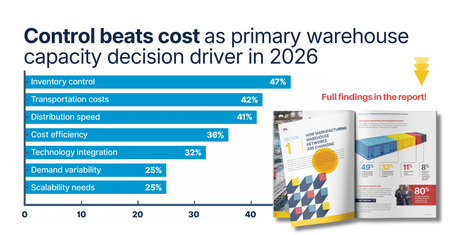
The warehouse is evolving from a place to hold materials or finished goods to a control point for production continuity, working capital, compliance, and service.
Control is not the same as ownership
Manufacturers have traditionally associated control with operating a warehouse themselves. WSI’s survey found that 49% still run their primary U.S. warehouse or distribution center with internal teams.
Ownership, however, does not automatically create control. A manufacturer can own the facility and still struggle with poor inventory accuracy, fragmented systems, inconsistent cycle counting, or limited visibility. A third-party operator can provide strong control when processes, data, accountability, and decision rights are clearly defined.
The more useful distinction is controlled versus reactive.
“Control does not have to mean owning every asset. It means having reliable inventory data, defined operating standards, and enough visibility to make decisions before a problem reaches production or the customer.” Said Adam Court, Vice President of Warehousing & Logistics at WSI.
Manufacturing inventory control is production control
For a manufacturer, warehouse inventory errors rarely stay inside the warehouse. A missing component can stop a production run, and material stored under the wrong status can be released too early or held too long. A lot-code discrepancy can complicate traceability, while finished goods in the wrong location can turn a routine shipment into an expedited transportation problem.
That is why manufacturing inventory control must extend beyond stock counts and connect receiving, quality status, production staging, replenishment, finished-goods storage, and outbound transportation. The warehouse model must support those connections without creating delays between systems or teams.
According to a recent study, 74% of warehouse decision-makers consider predicting inventory availability and confirming inventory accuracy among their most significant challenges. When inventory data cannot be trusted, planners compensate with extra stock, manual checks, and larger buffers. Those safeguards add cost without fixing the underlying problem.
When inventory data cannot be trusted, planners compensate with extra stock, manual checks, and larger buffers. Those safeguards add cost without fixing the underlying problem. A forecast gap between manufacturers and logistics partners can compound the issue by affecting labor, space, transportation, and production planning.
The cost of weak control appears elsewhere
A narrow warehouse comparison usually focuses on lease rates, labor, management fees, and equipment. Weak control creates expenses elsewhere in the operation.
It may appear as premium freight after an inventory discrepancy, lost production time while a team searches for material, excess stock held because records are unreliable, or customer deductions tied to incomplete shipments. In regulated operations, weak control can also become a traceability or audit problem.
The least expensive warehouse model is not necessarily the one with the lowest facility cost. It is the model that provides the required level of control with the lowest total operational exposure.
This is an important distinction when comparing an internally operated facility with a dedicated, contract, or shared warehouse. A lower rate loses its advantage quickly when weak processes require more safety stock, additional transportation, or repeated manual intervention.
Technology strengthens control when execution is disciplined
MHI’s 2026 Annual Industry Report found that 56% of supply chain leaders are increasing investment in supply chain technology and innovation, while 52% plan to spend more than $1 million.
Those investments can improve manufacturing inventory control, but only when the physical operation and system design match. A WMS cannot correct inconsistent receiving practices on its own.
Strong warehouse models combine technology with operating discipline. They establish how inventory is identified, scanned, stored, counted, reconciled, and reported. They also define how quickly exceptions are escalated and who has authority to act.
Better inventory management technology can improve visibility and reduce manual work, but only when the systems reflect what is happening on the warehouse floor. Effective inventory management also depends on consistent cycle counting, accurate forecasting, traceability, and reliable ERP and WMS integration.

What control should look like in a warehouse model
Before selecting or redesigning a warehouse model, manufacturers should test how control will work in practice:
- Can inventory be viewed by SKU, lot, status, and location without waiting for a manual report?
- Who owns cycle counts, reconciliation, root-cause analysis, and corrective action?
- How will the WMS, ERP, EDI, and other systems exchange and validate data?
- What happens when production, inbound volume, or customer demand changes?
- Which decisions remain with the manufacturer, and which are delegated to the warehouse team?
These questions apply to in-house, dedicated, contract, and multi-client environments.
A dedicated warehouse can preserve customized workflows, trained labor, committed capacity, and system integration while transferring daily management to an experienced operator. WSI’s dedicated warehousing services support purpose-designed facilities, customer operating standards, real-time visibility, and KPI reporting.
A shared or multi-client model may provide more flexibility for variable volume or regional expansion. It can still deliver strong control when the provider’s systems, inventory practices, and industry expertise fit the operation.
The right model protects control without protecting the status quo
WSI’s survey found that 88% of manufacturers expect their warehouse footprint to change within 18 months. At the same time, concern about losing operational control was the most common internal barrier to outsourcing. Manufacturers know their networks need to change, but they do not want flexibility to come at the expense of inventory confidence.
Control should therefore become a design requirement for change, not a reason to avoid it.
“Manufacturers are not just choosing between control and cost,” said Adam Court. “They are deciding which warehouse model gives them the strongest operational control at a cost the business can sustain.
The best warehouse model gives operations leaders confidence that inventory records reflect physical reality, processes can absorb change, and exceptions will surface early. Cost efficiency should follow from that foundation, not replace it.

About the Author

Alyssa Wolfe
Alyssa Wolfe is a content strategist, storyteller, and creative and content lead with over a decade of experience shaping brand narratives across industries including retail, travel, logistics, fintech, SaaS, B2C, and B2B services. She specializes in turning complex ideas into clear, human-centered content that connects, informs, and inspires. With a background in journalism, marketing, and digital strategy, Alyssa brings a sharp editorial eye and a collaborative spirit to every project. Her work spans thought leadership, executive ghostwriting, brand messaging, and educational content—all grounded in a deep understanding of audience needs and business goals. Alyssa is passionate about the power of language to drive clarity and change, and she believes the best content not only tells a story, but builds trust and sparks action.