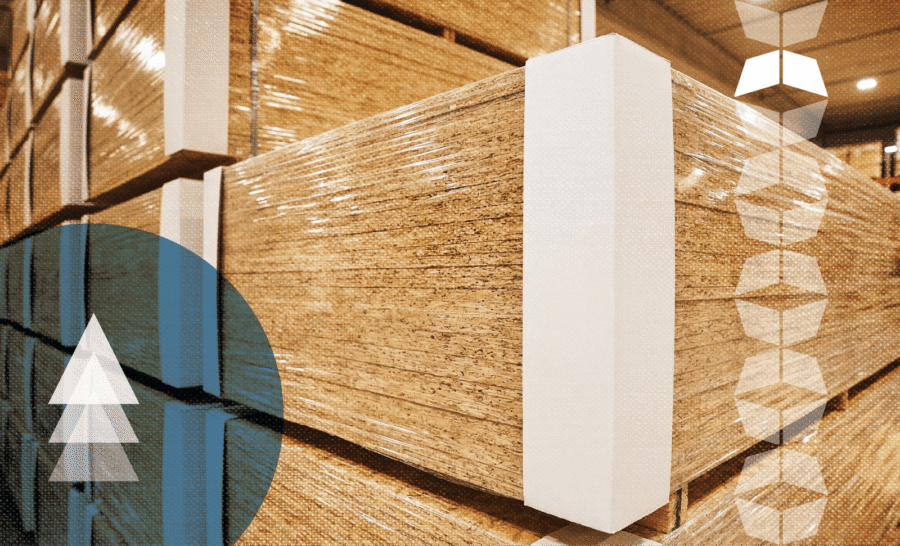
Supporting a Rail-Served, Regional Supply Chain
Manufacturing and building material distribution looks very different when products are oversized, heavy, and difficult to handle. In big & bulky warehousing environments, logistics partnerships aren’t easily replaced, and they aren’t built overnight. Moving freight that arrives by rail, weighs thousands of pounds, and requires specialized loading processes introduces a level of complexity that standard warehouse models aren’t built to support.
Add the need for regional reach and precise handling along with consistent service, and logistics quickly becomes a critical part of the operation.
When a ready-to-ship wood-based products manufacturer originally partnered with WSI, these realities shaped every distribution decision. WSI provided the specialized warehousing and rail expertise needed to manage big and bulky freight safely and efficiently. They also possessed the regional infrastructure to keep the product close to customers. It also started a partnership that has lasted well over a decade.
With the continued support of WSI, the company has achieved consistent, measurable performance across its Wisconsin distribution operation (based on 2025 performance):
- 100% on-time order fulfillment
- 100% inventory accuracy
- Consistent high-volume product movement
- Exceptional inbound accuracy
Expanding a Proven Model Built on a Long-Term Partnership
WSI’s customer is a U.S.-based manufacturer that specializes in engineered wood components for commercial doors, windows, and architectural applications. Founded in 1981, the company operates a growing network of manufacturing facilities across the Midwest, Southeast, and Pacific Northwest. It brings precision-driven, high-volume production to customers across the U.S. and Canada.
The company, recently acquired by a national manufacturer that works with materials used in the building and architectural market, has continued its long-standing logistics relationship with WSI; one built over 15 years through a Wisconsin distribution operation.

Today, the company continues to manufacture core door components, including rails, stiles, and cores, while high-density fiberboard (HDF) units are distributed through Wisconsin and Quebec. These HDF components serve as a critical structural and finishing element, holding together multiple door components before they are laminated, veneered, or primed for final use.
Raw materials originate in the Pacific Northwest and Canada, are produced in Montana, and distributed through WSI. From there, finished components are supplied to manufacturers across the U.S. and Canada, with a strong customer concentration in central Wisconsin.
Despite organizational growth and geographic expansion, the distribution strategy remains consistent.
“It’s business as usual,” the company’s plant manager says. “We’re still distributing out of Wisconsin, Indiana, and Quebec. Hopefully, we’re going to expand. That’s the goal.”
The Distribution Challenge Behind Heavy and Oversized Components
Serving customers across the Midwest requires inventory to be positioned close to market, handled correctly from the moment it arrives, and delivered on schedules customers can depend on.
Adding to the complexity, “our product is really hard to get off of a rail car,” the plant manager explains.
High-density fiberboard (HDF) doesn’t come in standard pallets. Components arrive in oversized bundles, often exceeding 10 feet in length, weighing thousands of pounds, and requiring specialized equipment just to unload from rail cars.
Most 3PLs can’t support this. Rail-served facilities are already uncommon. Facilities with the equipment, expertise, and space to safely handle long, heavy materials are even rarer.
The original decision to partner with WSI was driven by three non-negotiables:
- Access to rail-served warehousing
- Proximity to regional manufacturers
- Capability to handle building materials
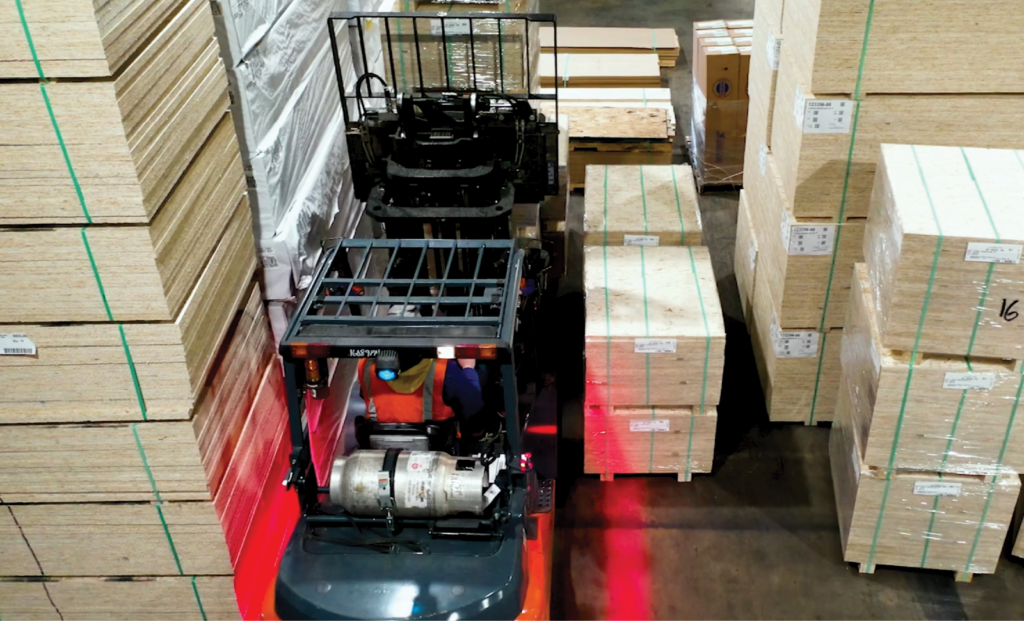
Post-acquisition, those requirements didn’t change. The product still arrives by rail. Customers are still concentrated in central Wisconsin. And the materials still require specialized handling that most 3PLs cannot support.
Why WSI: Proximity That Delivers
WSI’s Wisconsin facilities sit in the heart of the company’s customer base, enabling faster delivery cycles and lower freight costs. When manufacturers need components for production, lead times are measured in days, not weeks.
The location provides regional reach without unnecessary freight miles or transit delays. But the advantage is not just geographic.
WSI brings deep experience unloading rail cars and staging oversized materials, designing workflows specifically for heavy freight.
Product-specific solutions
Unloading oversized materials from rail cars is not a standard warehouse process and requires specialized equipment. Floor space configured for long materials and trained operators who can safely handle freight that cannot be moved with conventional forklifts are also needed.
WSI turned what would be a bottleneck at most facilities into a routine, repeatable process.
“That’s not something every warehouse can handle,” the plant manager explains.
Rather than forcing the product into a standard warehouse model, WSI adapted its operation to meet the product’s unique requirements.

A Commitment to Accuracy, Quality, and Efficiency
WSI and the manufacturer share a commitment to continuous improvement and high service quality standards.
To ensure operational KPIs are consistently met, WSI’s warehouse team focuses on careful inbound product inspections, unique SOPs tailored to material handling, and processes designed to avoid damage, loss, and waste
Warehouse teams count individual boards and confirm receipt details before inventory is accepted. This level of handling ensures accuracy even when inbound freight arrives imperfect, which is common in rail-served distribution.
Engineering Solutions for Oversized Freight
Inbound rail is only part of the equation. Outbound distribution introduces additional complexity, particularly when shipping via truckload.
Traditional dock loading methods are not always effective—or safe—for oversized product.
To solve this, WSI developed a curtain trailer loading process. Trailers back directly into the warehouse, curtains are lifted, and product is loaded from the side using a 6,000 lb. capacity counterbalance forklift with a hydraulic fork positioner attachment. This reduces handling risk while improving efficiency.
WSI operators are specifically trained and certified to handle both the unique freight and the specialized equipment required. Training includes standard OSHA forklift operation as well as attachment-specific instruction for devices like pallet handlers and clamps.
“They’ve figured out how to load our product in ways that just work,” says the company’s plant manager. “It’s efficient, and it protects the product.”
This reflects how the partnership operates overall: identify constraints, engineer around them, and build repeatable processes that support consistency at scale.
Operational Results That Matter
While the partnership is not defined by flashy KPIs, it consistently delivers reliability, safety, and operational consistency.
With the support of WSI, the company has achieved:
- 100% on-time order fulfillment
- 100% inventory accuracy
- Exception-level handling
- Efficient rail unloading
- Specialized truck loading
- Responsive customer service

A Partnership Built to Last
The partnership has lasted more than 15 years, with WSI evolving alongside the business while remaining operationally consistent.
From day-to-day coordination to long-term planning, WSI operates as an extension of the company’s team.
“The customer service has always been really strong,” the plant manager notes. “When we need something, we get answers. That matters.”
WSI’s ability to support multiple facilities has also provided flexibility as distribution needs shift across the broader network.
These outcomes allow the manufacturer to stay focused on production and customer relationships, confident that distribution is handled correctly—even when products are heavy, oversized, and difficult to move.
Connect with WSI today to learn more about how our team can help you handle complex, big and bulky, specialized products.
About the Author

Alyssa Wolfe
Alyssa Wolfe is a content strategist, storyteller, and creative and content lead with over a decade of experience shaping brand narratives across industries including retail, travel, logistics, fintech, SaaS, B2C, and B2B services. She specializes in turning complex ideas into clear, human-centered content that connects, informs, and inspires. With a background in journalism, marketing, and digital strategy, Alyssa brings a sharp editorial eye and a collaborative spirit to every project. Her work spans thought leadership, executive ghostwriting, brand messaging, and educational content—all grounded in a deep understanding of audience needs and business goals. Alyssa is passionate about the power of language to drive clarity and change, and she believes the best content not only tells a story, but builds trust and sparks action.