
While many supply chain leaders focused on the peak shopping season, holiday sales, and returns, transportation policy and freight market dynamics continued to move quickly. Over the past month, a series of announcements from the U.S. Department of Transportation (DOT), along with emerging capacity signals in the trucking market, point to a more regulated, infrastructure-heavy, and less forgiving freight environment for 2026.
Looking at the whole picture, these recent developments highlight a clear reality for shippers: transportation planning is becoming more complex, and the margin for error is narrowing.
$118 million investment raises the bar on CDL safety and enforcement
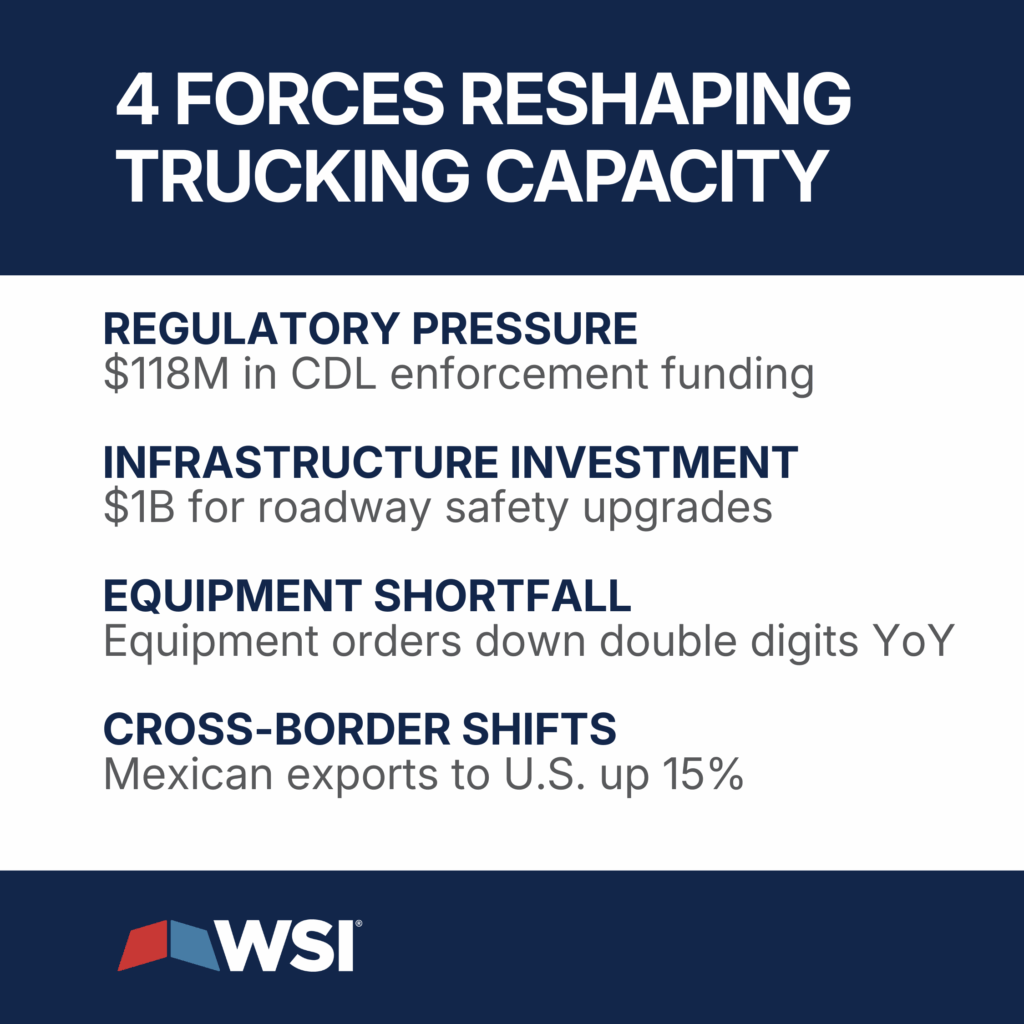
On December 30, 2025, the DOT announced more than $118 million in grant funding through the Federal Motor Carrier Safety Administration (FMCSA) to strengthen Commercial Driver’s License (CDL) oversight, enforcement, and training. The initiative, announced by Transportation Secretary Sean P. Duffy, focuses on keeping unqualified drivers off the road while improving nationwide safety outcomes.
The implications for shippers are mixed. While stronger enforcement and improved training support long-term safety and stability, tighter oversight can restrict driver availability in certain regions or corridors, especially where compliance gaps already exist.
“This investment reinforces that compliance and safety are no longer optional variables in freight planning but are foundational to capacity availability,” said David Stone, Director of Transportation at WSI. “As enforcement tightens, shippers need to understand where capacity may thin and plan accordingly.”
CDL compliance disputes could disrupt driver supply
In addition to the new funding, the DOT has also indicated continued scrutiny of state-level CDL programs. Public statements made around potential funding withdrawals tied to CDL issuance standards create an ongoing regulatory wildcard for the trucking industry.
Freight stakeholders are less concerned about a single enforcement action and more about uneven implementation across states. Differences in how CDL standards are enforced can create regional imbalances in driver availability, especially when legal challenges or policy reversals delay clarity.
Freight brokers will play a critical role in monitoring these developments and adjusting carrier strategies in real time, something that is increasingly difficult for shippers to manage internally as regulatory signals shift.
Nearly $1 billion in roadway safety funding aims to accelerate infrastructure upgrades
Just days before the CDL announcement, the DOT announced nearly $1 billion in funding for roadway safety improvements through the Safe Streets and Roads for All (SS4A) program. The funding supports 521 projects across 48 states, tribal communities, and Puerto Rico, with a focus on reducing serious injuries and fatalities.
The projects include intersection redesigns, roundabouts, pedestrian and cyclist safety improvements, upgraded emergency communications, and traffic incident management facilities. According to the Department, the program was streamlined to accelerate funding deployment and remove application barriers that previously slowed project approvals.
For freight networks, infrastructure investment is a long-term positive but not without near-term friction.
“Infrastructure upgrades ultimately improve reliability, but during construction phases they introduce temporary chokepoints,” said Stone. “Those disruptions can create unpredictable transit times if shippers aren’t proactively routing freight around active projects.”

Capacity tightens as equipment orders hit historic lows
At the same time regulatory pressure is increasing, structural capacity indicators suggest the U.S. trucking market is operating with less built-in slack than in prior years. According to reporting from FreightWaves, executives at Uber Freight note that tractor and trailer orders remain down double digits year over year.
The slowdown is especially pronounced in:
- Class 8 sleeper tractors, which are essential for long-haul capacity
- Dry van trailers, a cornerstone of general freight movement
- Refrigerated trailers, which support food, beverage, and pharmaceutical supply chains
Low equipment orders signal limited near-term fleet expansion, even as demand fluctuates. Carrier exits over the past two years have further reduced the industry’s ability to absorb sudden surges.
This dynamic creates what freight leaders describe as “less buffer during demand spikes.” In practice, that buffer loss affects both sides of the market.
For carriers, fewer spare tractors and trailers mean less flexibility to add capacity during seasonal or promotional surges. For shippers, it translates into higher exposure to spot market volatility, tighter tender acceptance, and reduced service consistency when volumes rise unexpectedly.
Cross-border freight with Mexico offers relief but brings complexity
Despite tightening domestic capacity, cross-border freight between the U.S. and Mexico is emerging as a stabilizing force. FreightWaves also highlighted that Mexican exports to the U.S. are up roughly 15%, driven by sustained manufacturing activity and supply chain adjustments related to tariffs and sourcing strategies.
Cross-border flows are helping to offset softness in other segments of the trucking market. However, they also introduce added complexity around customs compliance, security, and contingency planning.
“Shippers moving cross-border freight are planning for disruptions as a baseline assumption,” Stone said. “That includes alternate ports of entry, backup carriers, and clear documentation to avoid delays.”
Why freight brokerage matters more in 2026
Between the convergence of policy changes, infrastructure projects, enforcement actions, and capacity constraints, freight brokerage is shifting from a transactional role to a strategic one.
Modern freight brokers provide:
- Scenario-based capacity planning across soft and tight markets
- Access to compliant, vetted carrier networks
- Alternate routing strategies during infrastructure disruptions
- Real-time regulatory and market intelligence
Stone said, “Shippers that rely on a single forecast or a static carrier strategy are exposed in this market. Flexibility and visibility are what protect service levels when conditions change quickly.”
Looking ahead
Federal investments in safety and infrastructure show a long-term commitment to improving the transportation system. In the near term, however, shippers face a more regulated, capacity-constrained, and operationally complex freight environment.
As 2026 approaches, transportation strategies built around compliance, adaptability, and expert brokerage support will be better positioned to navigate what comes next.
Talk to WSI’s freight brokerage experts
In a transportation market defined by regulatory shifts, tightening capacity, and more complex compliance requirements, shippers need a partner with deep industry insight and trusted carrier relationships. WSI’s award-winning 3PL freight brokerage connects your business to a nationwide network of more than 75,000 vetted carriers, helping you secure competitive rates and reliable capacity for FTL, LTL, drayage, intermodal, specialized, and expedited shipments. With advanced technology, real-time visibility, and dedicated support every step of the way, WSI simplifies freight management so your team can focus on growth, not logistics hurdles.
Contact a freight brokerage specialist today to optimize your shipping strategy and build resilience into your supply chain
About the Author

Alyssa Wolfe
Alyssa Wolfe is a content strategist, storyteller, and creative and content lead with over a decade of experience shaping brand narratives across industries including retail, travel, logistics, fintech, SaaS, B2C, and B2B services. She specializes in turning complex ideas into clear, human-centered content that connects, informs, and inspires. With a background in journalism, marketing, and digital strategy, Alyssa brings a sharp editorial eye and a collaborative spirit to every project. Her work spans thought leadership, executive ghostwriting, brand messaging, and educational content—all grounded in a deep understanding of audience needs and business goals. Alyssa is passionate about the power of language to drive clarity and change, and she believes the best content not only tells a story, but builds trust and sparks action.