You’ve decided to explore rail freight. Maybe truck capacity is tight, costs are rising, or your volumes are finally large enough to justify a different mode. You call a Class I railroad to start the conversation, and it doesn’t go as expected.
They ask about volume commitments and mention constructive placement. The pricing structure looks nothing like your truck contracts. Suddenly, it feels like you’ve stepped into a different industry with its own language, rules, and risk profile.
Rail logistics can be a powerful cost and capacity lever for shippers and manufacturers, but only if you understand how the system works. Unlike trucking, railroads are optimized for network efficiency, asset utilization, and long-term volume, which means the terms they use carry operational and financial consequences.
This guide breaks down the most important rail logistics terms shippers need to know. Whether you’re evaluating rail for the first time or trying to avoid costly surprises, understanding this language is the first step toward having productive, informed conversations with Class I railroads.
Understanding class I railroad priorities
Class I railroads evaluate freight opportunities very differently from trucking carriers because they operate large, interconnected networks rather than point-to-point lanes. Their decisions are shaped by volume density, asset utilization, network efficiency, and long-term commitments—factors that often make early rail conversations feel unfamiliar to manufacturers new to rail.
Rail networks perform best when volume density is high, and shipments are large and consistent, moving over long distances. Dense lanes allow railroads to build longer, heavier trains on high-traffic corridors, improving efficiency across the system. Sporadic shipments or low-volume moves are harder to absorb because they don’t contribute meaningfully to train length or network flow, which is why rail pricing and service tend to favor predictable, repeatable freight.
That same systemwide thinking carries over to asset utilization. Railcars, locomotives, and yard space are capital-intensive, and every hour a car sits idle reduces overall network productivity. From a railroad’s perspective, minimizing dwell time—cars waiting to be loaded, unloaded, or moved—is essential to keeping freight flowing.
Routing and scheduling decisions are made to optimize the entire system, not individual shippers, to maintain network efficiency. Rail networks are highly interconnected, and a disruption in one location can ripple across regions and corridors.
Long-term commitments also play a central role in how railroads plan and invest. Billions of dollars are poured into track, terminals, signaling, and equipment each year, with infrastructure decisions tied closely to projected volume. Stable, contracted freight provides the confidence railroads need to allocate capacity and plan for the future, often in exchange for more consistent rates or service levels.
Rail logistics terms that directly cost you money
Several core rail terms directly affect what shippers actually pay, and they’re often the source of the biggest surprises for first-time rail shippers. Understanding these terms upfront can help you avoid unplanned charges and budget rail moves more accurately.
1. Demurrage
Demurrage is a penalty fee charged when a railcar is held beyond the allowed loading or unloading window, known as free time. Once that free time expires, the railroad begins charging a daily fee for every additional day the car remains in your possession. This is the most common and costly surprise for manufacturers new to rail. Demurrage charges can range from $100 to $200 or more per day, per car, and typically begin after 24-48 hours.
For example, you get a railcar spotted or placed at your facility on Monday, giving you 48 hours of free time. If the car isn’t fully loaded or unloaded and released by Wednesday, demurrage charges begin on Thursday and continue until the car is cleared from your site. Labor delays, equipment availability, or miscommunication between teams can all extend dwell time and drive unexpected costs.
2. Free time
Free time is the limited window a railroad allows a shipper to load or unload a railcar after it has been spotted (placed) at a facility, before demurrage charges begin to apply.
For most carload shipments, free time is typically 24 to 48 hours, though the exact allowance varies by railroad, the type of move, and the facility involved. Intermodal shipments often follow different free time rules, which can vary by terminal and service type. One common source of confusion is whether weekends and holidays count towards free time, so it’s best to read the fine print!
Because free time governs when demurrage starts, misunderstandings about timing can quickly lead to unexpected charges. Having labor and equipment ready before the car arrives allows loading or unloading to occur within the allotted window. It helps prevent daily penalties that weren’t anticipated when the rate was quoted.
3. Fuel surcharge
A fuel surcharge is a variable charge based on diesel prices that is added to the base rate. It fluctuates over time and is typically updated monthly, with current rates published by each railroad.
Fuel surcharges can significantly increase the actual cost of a rail move, often adding 15 to 30 percent to the quoted rate. Because fuel surcharge details are usually buried in rate sheets or contract terms rather than highlighted upfront, one of the most important questions to ask when comparing rail rates is: “What’s your current fuel surcharge?”
4. Accessorial charges
Accessorial charges are additional fees applied beyond the base transportation rate. In railroad logistics, these charges cover services or situations that fall outside standard transportation pricing.
Common accessorial charges include switching fees, storage, reconsignment, and special handling. While each charge may seem incremental on its own, these “extras” can double your actual cost versus the quoted base rate.
For manufacturers new to rail logistics, accessorial charges are often the reason actual transportation costs exceed expectations. A low base rate paired with high accessorial charges is a red flag that typically results in an expensive move.

Rail logistics terms that define your service level
Cost is only part of the rail logistics equation. Service levels, such as how long freight takes to move, how reliably it arrives, and how much handling occurs along the way, are shaped by a different set of terms. Understanding these concepts helps manufacturers set realistic expectations and evaluate whether rail service aligns with their operational needs.
5. Interchange
An interchange is where one railroad hands cars to another to complete a move, typically when switching networks. Each interchange introduces additional switching, potential delays, and increased handling, adding 1 to 3 days to transit time and increasing the risk of delays or damage.
A better option for faster, more predictable service is single-line service, in which one railroad handles the move from the point of origin to the destination. For example, a Chicago-to-Los Angeles move on BNSF is single-line service, and a Chicago-to-Atlanta shipment that moves from BNSF to CSX with only one interchange.
6. Transit time
Transit time is the time from when the railroad receives the shipment to when it becomes available at the destination terminal.
Unlike trucking, rail transit time is not measured door-to-door. It does not include loading time, drayage to or from a terminal, or the time the railcar may spend sitting at your facility before or after movement. As a result, the published transit time often appears shorter than the time it actually takes to move the shipment.
When evaluating service, it’s important to ask specifically, “What’s the average transit time for this land, and what’s the variance?”
7. Transload
A transload facility is where freight is transferred from rail to truck, or vice versa. Transloading allows manufacturers to use rail service without having a rail siding at their own facility.
For most manufacturers without direct rail access, transloading is the primary way rail fits into their supply chain. While it adds a cost of $150 to $500 or more per load and typically adds one to three days to the overall timeline, it provides rail access without the capital expense of building a rail siding.
8. Spot/spotting
Spot, or spotting, refers to when a railroad positions a car at your loading or unloading location. It’s common to hear this term used frequently in day-to-day rail operations. When someone asks, “When will you spot the car?” they are asking when it will be ready to be loaded or unloaded.
In day-to-day operations, you’ll hear this term constantly. When someone asks, “When will the car be spotted?” they are asking when the car will be placed and available for work. Spotting is a key operational milestone, as it often determines when free time begins.
You may also hear the term constructive placement, which occurs when a railroad can’t physically spot a car due to something at your facility that prevents placement—typically referred to as “your issue.” In these circumstances, the railroad doesn’t physically spot the car, but the clock starts anyway.
Rail logistics terms that affect what you pay
Beyond timing and service levels, several core rail terms directly influence pricing structure and long-term cost. These concepts shape how rates are quoted, negotiated, and enforced. Understanding these terms facilitates informed rail logistics decisions.
9. Carload vs. intermodal
Selecting between carload and intermodal rail transport is a fundamental choice that determines economics and service. Carload service moves freight in individual railcars. It typically consists of bulk or heavy shipments and often requires volume commitments, generally offering a better cost per ton.
In contrast, intermodal service moves freight in containers placed on trains and is best suited for smaller volumes and faster, more flexible service with a higher per-unit cost. Choosing the wrong option can mean paying more than necessary or getting the wrong service.
10. Base rate
The base rate is the core transportation charge before fuel surcharges, accessorial charges, or other add-ons are applied. They are quoted per railcar, per container, or per hundredweight (cwt), depending on the type of service and commodity. While this number is often the focal point of negotiations, it represents only the starting point—not the final cost. To avoid confusion, it’s best always to ask: “What’s included in the base rate and what’s extra?”
11. Volume commitment
A volume commitment is a contractual promise to ship a minimum number of railcars or containers over a defined period, such as a month, quarter, or year. Better rates are often tied to these volume promises. However, failure to meet the commitment typically results in penalties, rate increases, or the loss of negotiated pricing altogether. Therefore, it’s best to be realistic when considering these commitments. For instance, don’t commit to 50 cars per month if you can realistically only do 20.
Rail logistics terms about how it works
These foundational rail terms explain how a rail shipment is executed and managed once it enters the rail system and how they impact reliability and control.
12. Manifest vs. unit train
Manifest and unit trains specify how railcars are grouped and moved through the network, determining service frequency and pricing structure.
A manifest train, often selected by manufacturers, carries mixed freight from multiple shippers on scheduled routes two to three times per week. By contrast, a unit train consists of 100 or more railcars of a single commodity, moving as a dedicated service, most suitable only for very high-volume shippers. Most manufacturers ship via manifest. You shouldn’t expect unit train service unless you’re moving coal or grain on a massive scale.
13. Bill of Lading (BOL)
A Bill of Lading (BOL) contains your formal instructions to the railroad, specifying what is being shipped, where it is going, how much is in the shipment, and who is responsible for payment. A BOL is your shipping contract and receipt, so it’s essential not to make mistakes when preparing this document. Otherwise, your shipment could be sent to the wrong destination, billed incorrectly, or delayed. Key fields on this contract include the consignor (the shipper), the consignee (the receiver), the commodity being shipped, the required car type, and routing instructions.
14. Single-line service
Single-line service refers to movement by one railroad from origin to destination. Because there are no interchanges or handoffs, single-line service is typically faster, more reliable, and easier to manage than multi-railroad routes. Fewer handoffs mean fewer delays, less coordination, and greater transparency in accountability for service performance.
For example, a Chicago-to-Mexico move handled entirely by CPKC is single-line service and represents a key competitive advantage. Single-line routes offer premium value, worth paying slightly more for versus multi-railroad routes, due to their reliability and simplicity.
One term about pricing structure
Some rail logistics terms affect cost or service. This one determines how your rate is established—and whether it’s public or negotiated.
15. Tariff vs. contract rate
The difference between a tariff and contract rate determines whether your rail pricing is public or negotiated. A tariff consists of published rates filed with the government as public record, and are usually higher than those rates. By contrast, a contract rate is negotiated, confidential pricing based on your volume with the railroad. In practice, most manufacturers negotiate contract rates, using tariffs as a baseline. Accepting a tariff rate without negotiation typically means paying more than necessary.
The “print this out” cheat sheet version
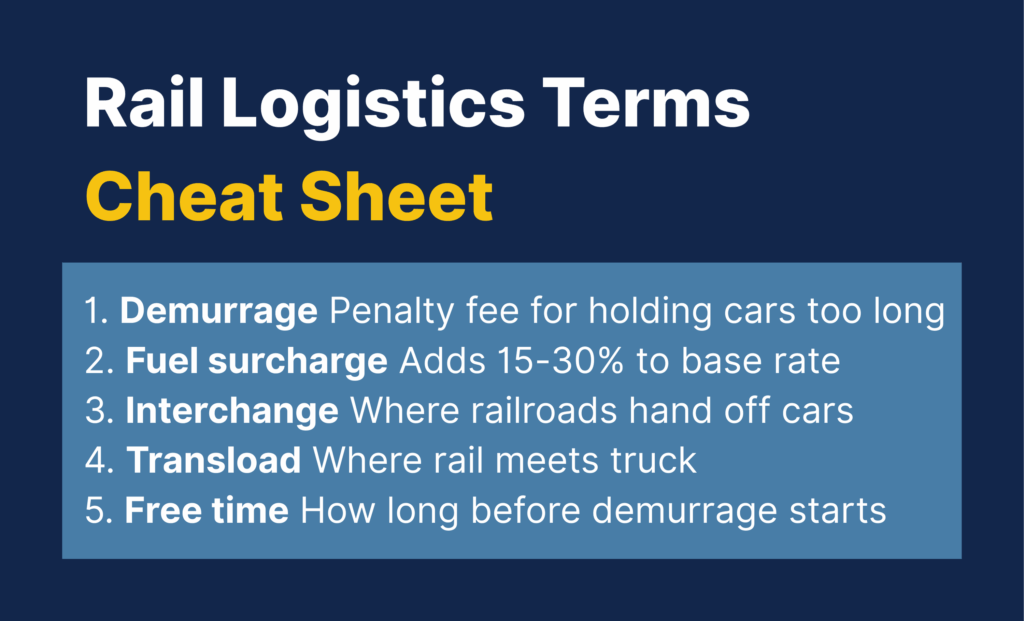
If you only remember 5 terms:
- Demurrage – Daily penalty fee for holding cars too long → Plan your loading schedule
- Fuel surcharge – Adds 15-30% to base rate → Always ask what it is today
- Interchange – Where railroads hand off cars → Each one adds delays
- Transload – Where rail meets truck → How you use rail without a siding
- Free time – How long before demurrage starts → 24-48 hours typically
Turning rail logistics complexity into clarity
Rail can be a powerful tool for shippers and manufacturers looking to control costs, add capacity, and build resilience into their supply chains, but only when it’s understood and managed correctly. Rail logistics operates under different rules than trucking, with its own pricing structures, service models, and operational constraints. As this guide shows, the terms railroads use directly affect cost, service reliability, and risk.
Understanding these 15 rail logistics terms gives manufacturers a stronger foundation for productive conversations with Class I railroads and more confidence when evaluating rail as part of their transportation strategy.
You don’t need to become a rail expert. Partner with someone who already is.
WSI helps manufacturers navigate rail logistics end to end, from transload operations and rail-served facilities to carrier coordination and cost control. With deep rail experience and a practical, operations-first approach, WSI acts as the translator between manufacturers and the rail network—helping rail moves perform as planned, not as surprises.
Ready to explore rail with confidence? Connect with WSI to see how our rail-served network and logistics expertise can support your operation.
Frequently Asked Questions
Q: What’s the most common cause of demurrage?
A: The most common causes of rail demurrage fees are labor delays and inventory constraints preventing timely unloading.
Q: How much does rail demurrage typically cost?
A: Rail demurrage typically costs $100-200 per day per car, escalating to $300+ for extended delays.
Q: Can I dispute demurrage charges?
A: Yes, you can dispute demurrage charges but you have only 5 days from each railcar event to file a dispute.
Q: how do I calculate rail demurrage charges?
A: To calculate potential rail demurrage costs, multiply your number of railcars by average days beyond free time by the daily demurrage rate. For example: 50 railcars per month × 20% exceeding free time × 3 average days over × $150 per day = $4,500 monthly or $54,000 annually in demurrage exposure. However, actual costs are more complex because demurrage rates escalate over time (often starting at $100-150/day for days 1-2, increasing to $200-250/day for days 3-5, and $300+/day beyond that). You should also factor in which charges might be disputable (railroad service failures, weather delays over 2 days, improper billing) versus legitimate charges (your own operational delays). To get an accurate assessment, track your actual dwell time per railcar over 90 days, note which delays were your fault versus railroad-caused, and apply current demurrage rate schedules from your serving railroads.
Q: What’s the difference between demurrage and detention?
A: Demurrage and detention are both delay-related charges, but they apply to different modes. Demurrage is charged by railroads when railcars are held too long at a facility beyond free time (typically 24-48 hours). Detention is charged by trucking carriers when trailers are held beyond the agreed drop/hook timeframe (typically 2-4 hours for live loads or 24 hours for drop trailers). Rail demurrage is generally more expensive ($100-300+ per day) and has stricter dispute processes (5-day deadline) compared to truck detention ($50-100 per day with more flexible resolution). Another key difference: rail demurrage charges often escalate daily, while truck detention is typically a flat rate. Both exist to incentivize efficient use of transportation equipment, but rail demurrage is more complex because it involves multiple events (constructive placement, actual placement, release) that each trigger separate free time calculations and potential charges.
About the Author

Margot Howard
Margot Howard is a Freelance content marketing writer and strategist with 10+ years of experience. Margot worked in corporate sales for many years before transitioning to content marketing. She writes for B2B SaaS, software, and service companies, especially those in shipping and logistics, Sales Tech, and MarTech.